
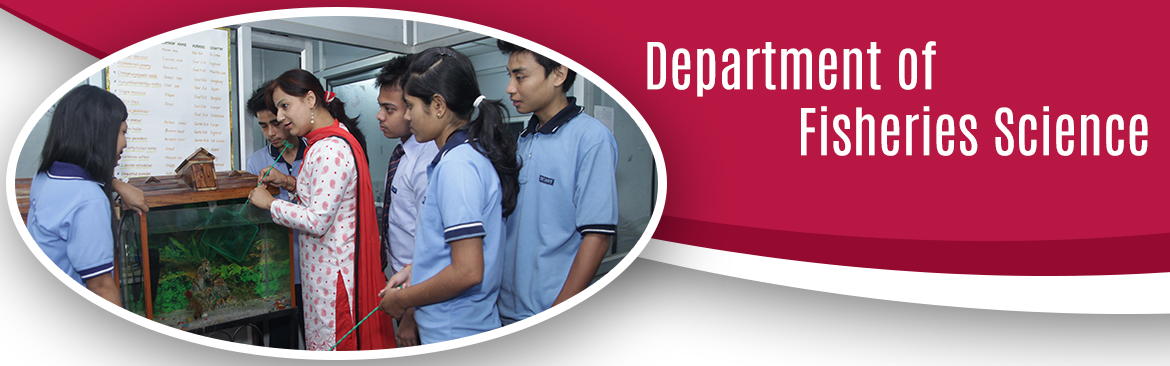
Department of Fisheries Science
The Department offers both undergraduate and postgraduate courses in Fisheries Science
Fisheries is a multidisciplinary field that focuses on the conservation, management and sustainable utilization of aquatic resources. It encompasses the study of fish biology, aquatic ecosystems, aquaculture, capture fisheries, fish nutrition, genetics, health management and post-harvest technology. By integrating scientific knowledge with practical applications, fisheries play a vital role in increasing aquatic food production, ensuring food security and supporting the livelihoods of millions of people. The sector contributes significantly to national economies through aquaculture, inland and marine capture fisheries, seed production, fish processing, export and allied industries. With growing global demand for healthy and protein-rich food, fisheries has emerged as one of the fastest-growing food production sectors. Advances in technology—such as biofloc, RAS, GIS, remote sensing, genetic improvement and disease diagnostics—continue to transform the field, making it more efficient, environmentally responsible and economically viable. Overall, fisheries is a dynamic and impactful discipline dedicated not only to food production but also to ecosystem conservation, rural development and sustainable natural resource management.
Thrust areas:
- Sustainable Aquaculture Development: Advancing eco-friendly farming systems such as biofloc, RAS, cage culture, pen culture, and integrated multitrophic aquaculture (IMTA).
- Fish Health & Biosecurity: Strengthening diagnostics, prophylaxis, therapeutants, and biosecurity strategies to minimize disease outbreaks.
- Fish Nutrition & Feed Technology: Developing cost-effective, nutritionally balanced, and species-specific feeds using alternative protein sources and precision formulation.
- Breeding & Seed Production: Improving broodstock management, induced breeding technologies, larval rearing, and genetic enhancement of commercially important species.
- Fisheries Resource Management: Promoting sustainable exploitation, habitat conservation, stock assessment, and ecosystem-based management.
- Climate-Resilient Fisheries: Assessing climate impacts and developing adaptive practices to ensure resilience of aquaculture and capture fisheries.
- Post-Harvest Technology & Value Addition: Enhancing quality control, processing, packaging, and value-added product development for domestic and export markets.
- Extension, Training & Entrepreneurship: Capacity-building of farmers, youth, and stakeholders, and supporting start-ups in aquaculture and fisheries enterprises.
F.Sc. (Bachelor of Fisheries Science)
This four-year undergraduate program provides foundational knowledge of aquaculture, fish biology, aquatic ecology, fish nutrition, breeding, genetics, health management and aquaculture engineering. Students gain hands-on experience through practicals, farm training and rural fisheries work experience programs. The course prepares students to understand and manage freshwater, brackish water and marine aquaculture systems efficiently and sustainably.
F.Sc. (Master of Fisheries Science) – Aquaculture
The M.F.Sc. program offers advanced specialization in aquaculture, including broodstock development, induced breeding, larval rearing, feed formulation, water quality management, disease diagnostics, biotechnology, microbial management, biofloc systems, RAS and sustainable intensification technologies. Students engage in research, thesis work, and industry-linked projects, enabling them to develop innovative solutions for high-density and environment-friendly farming systems.
Career Opportunities
Graduates and postgraduates in aquaculture have a wide range of job prospects in both government and private sectors. Opportunities include roles such as Fisheries Officer, Aquaculture Technician, Farm Manager, Hatchery Manager, Feed Mill Executive, Research Scientist, Extension Officer, Quality Control Analyst, and Consultant. They can work in fisheries departments, aquaculture farms, hatcheries, research institutes, seafood processing industries, biotech labs and NGOs. Entrepreneurship opportunities exist in fish farming, ornamental fish culture, seed production, feed manufacturing and aquaculture equipment enterprises. M.F.Sc. graduates may also pursue teaching, research and doctoral studies for academic careers.


