
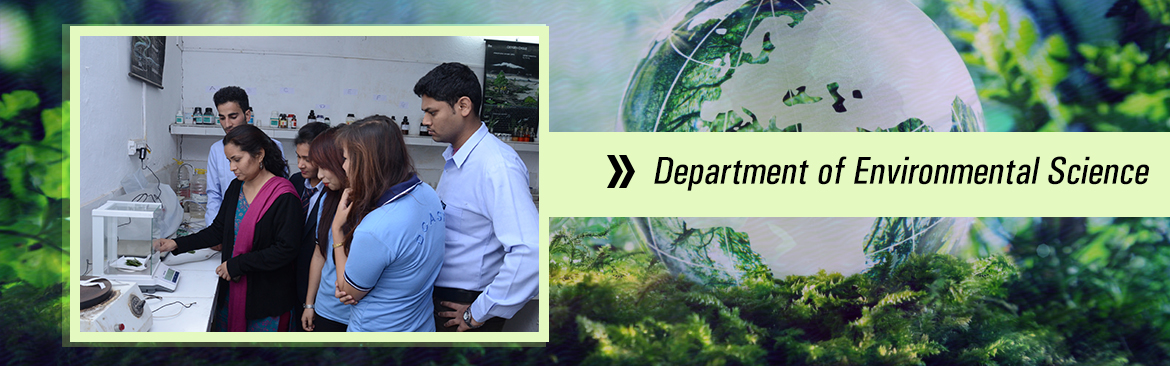
Department of Environmental Science
The Department has offered an M.Sc. program in Environmental Sciences since its inception. It is committed to delivering high-quality environmental education and advancing research that addresses the world’s most pressing ecological challenges. Guided by the principle that science and technology should serve humanity, the department integrates academic excellence with a strong focus on sustainability and innovation.
Equipped with advanced laboratories and modern analytical tools, the department offers students hands-on experience in experimental techniques, fieldwork, and data-driven environmental assessments. The curriculum blends theoretical knowledge with practical exposure, while workshops, expert lectures, internships, and research projects help students develop critical thinking, problem-solving abilities, and independent research skills.
The department also encourages active participation in community outreach, environmental awareness programs, and collaborative initiatives with government, industry, and NGOs.
Key Research Areas
- Phytoremediation and Bioremediation
- Water Quality Analysis
- Environmental Pollution Monitoring and Control
- Biodiversity and Ecosystem Studies
- Climate Change
- Traditional and Indigenous Knowledge Systems
- Sustainable Resource and Waste Management
Career Opportunities
Graduates with an M.Sc. in Environmental Science can explore a wide range of career opportunities across academic, government, research, industrial, and nonprofit sectors. They may take up teaching or research roles in colleges and universities, or work in various government departments and agencies such as Forest and Environment Departments, Pollution Control Boards, Water Resources, Agriculture, Rural Development, Disaster Management, and Educational Services. Many also pursue careers in research and development within national or private institutes focused on environmental sustainability, climate science, ecological restoration, and green technologies. In the industrial sector, professionals can contribute to Environmental Impact Assessment (EIA), sustainability consulting, waste management, environmental compliance, renewable energy, and work in industries like fertilizers, textiles, pharmaceuticals, and food processing. NGOs offer roles in advocacy, conservation, policy implementation, community development, and environmental education. Additionally, there are ample opportunities for entrepreneurship, including launching environmental consulting firms, eco-friendly ventures, pollution testing laboratories, and sustainability-focused startups.
The Department of Environmental Sciences prepares students to become skilled professionals and responsible global citizens. Through its academic programs, research initiatives, and community engagement, the department fosters leadership, innovation, and a lifelong commitment to environmental stewardship and sustainable development.


